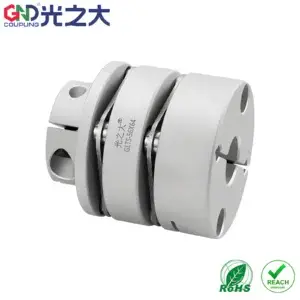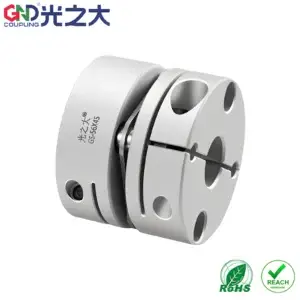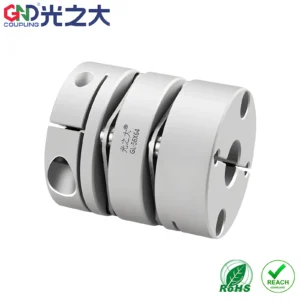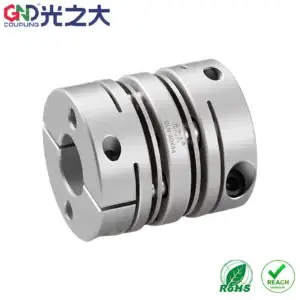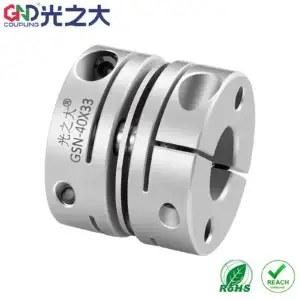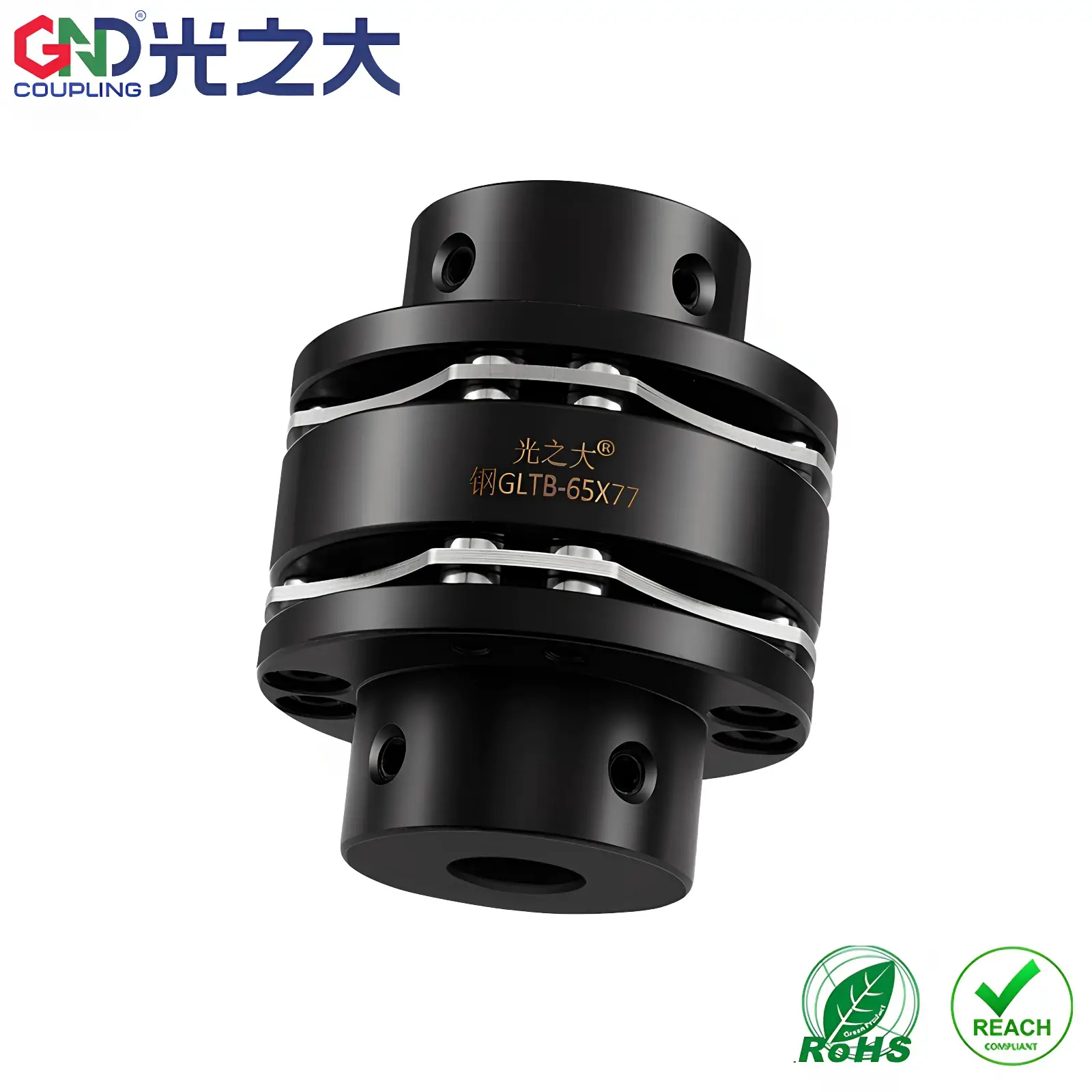
GLTB series high-rigidity disc coupling with a 45# carbon steel body in a black oxide finish and 304 stainless steel diaphragms. It transmits torque with zero backlash and very high torsional stiffness, which is what a servo-driven ball screw or a CNC axis needs to hold position. Supplied in double-disc form for angular, parallel and axial misalignment, and single-disc form where only angular and axial misalignment have to be taken up. Outer diameters 26 to 126 mm, bores 5 to 48 mm.
Technical specifications
| Series | GLTB |
|---|---|
| Coupling type | Disc (diaphragm) coupling, zero backlash |
| Body material | 45# carbon steel |
| Diaphragm material | 304 stainless steel |
| Surface treatment | Black oxide |
| Configurations | Double disc and single disc |
| Shaft attachment | Set screw clamping on each hub |
| Outer diameter range | 26 mm to 126 mm |
| Bore range | 5 mm to 48 mm depending on size |
| Keyway | Keyway machining available on request |
| Backlash | Zero |
| Misalignment | Double disc takes angular, parallel and axial; single disc takes angular and axial |
| Brand and origin | GND / Guangzhida, Dongguan, China |
| Typical applications | Servo and stepper driven ball screws, CNC axes, linear modules, machine tool feed drives, test rigs |
Available sizes
Sizes are given as outer diameter x overall length. Each one is ordered with the two bore diameters you need, one for the driving shaft and one for the driven shaft, anywhere inside the bore range shown.
| Size (outer diameter x length) | Bore range |
|---|---|
| Double disc, 26 x 35 mm | 5 to 10 mm |
| Double disc, 32 x 41 mm | 6 to 12 mm |
| Double disc, 34 x 45 mm | 6 to 12 mm |
| Double disc, 39 x 50 mm | 6 to 15 mm |
| Double disc, 44 x 50 mm | 6 to 15 mm |
| Double disc, 56 x 64 mm | 10 to 20 mm |
| Double disc, 65 x 77 mm | 12 to 32 mm |
| Double disc, 87 x 94 mm | 17 to 38 mm |
| Double disc, 94 x 98 mm | 17 to 42 mm |
| Double disc, 104 x 112 mm | 19 to 48 mm |
| Double disc, 126 x 126 mm | 19 to 48 mm |
| Single disc, 65 x 55.5 mm | 12 to 32 mm |
| Single disc, 87 x 67 mm | 17 to 38 mm |
| Single disc, 94 x 68 mm | 17 to 38 mm |
| Single disc, 104 x 80 mm | 19 to 48 mm |
| Single disc, 126 x 91 mm | 19 to 48 mm |
How to order
Couplings are quoted per order, with no price shown on the site. Send us the series GLTB, the outer diameter and length you need, and the two bore diameters, for example GLTB-65X77 with 14 mm and 20 mm bores. If you do not know which size fits, send the motor shaft diameter, the driven shaft diameter, the torque and the space available between the two shafts, and our engineers select it for you. RendatSP ships to Saudi Arabia, Iraq, the UAE, Egypt, Oman, Libya, Morocco, Mauritania, Yemen, Algeria, Jordan and Syria.
Frequently asked questions
Should I use the double-disc or the single-disc version?
Use double disc when the two shafts may be offset sideways, which is the normal case on a motor and ball screw assembled in a machine frame. Use single disc only when the shafts are concentric and you need the shortest possible body, because a single disc pack cannot take parallel offset without loading the bearings.
Why choose a disc coupling over a jaw coupling?
A disc coupling has no elastomer, so it has zero backlash and much higher torsional stiffness. That is what preserves positioning accuracy on a servo axis. A jaw coupling damps vibration better and is more forgiving, which suits pumps and general drives but not precision positioning.
Can you machine a keyway in the bore?
Yes. Keyway machining is available as an extra operation. Tell us the bore diameter and the keyway standard you need when you ask for the quotation.
What torque will a given size carry?
Rated torque rises with the outer diameter and with the number of disc packs. Tell us the size you are considering and the torque your drive produces and we confirm the rated and peak figures from the manufacturer table before you order.
How do I fit it without damaging the discs?
Slide both hubs onto the shafts before tightening anything, keep the gap between shaft ends as specified, and tighten the set screws evenly. Never force the coupling axially onto a shaft, because the load goes straight through the thin stainless discs.