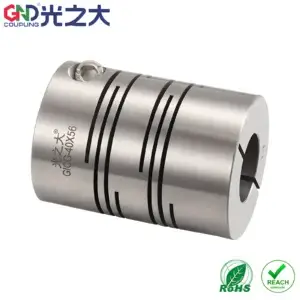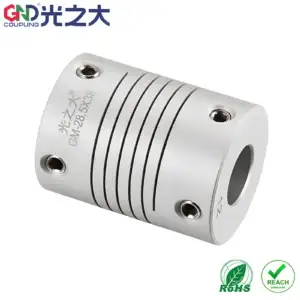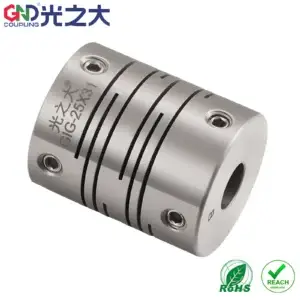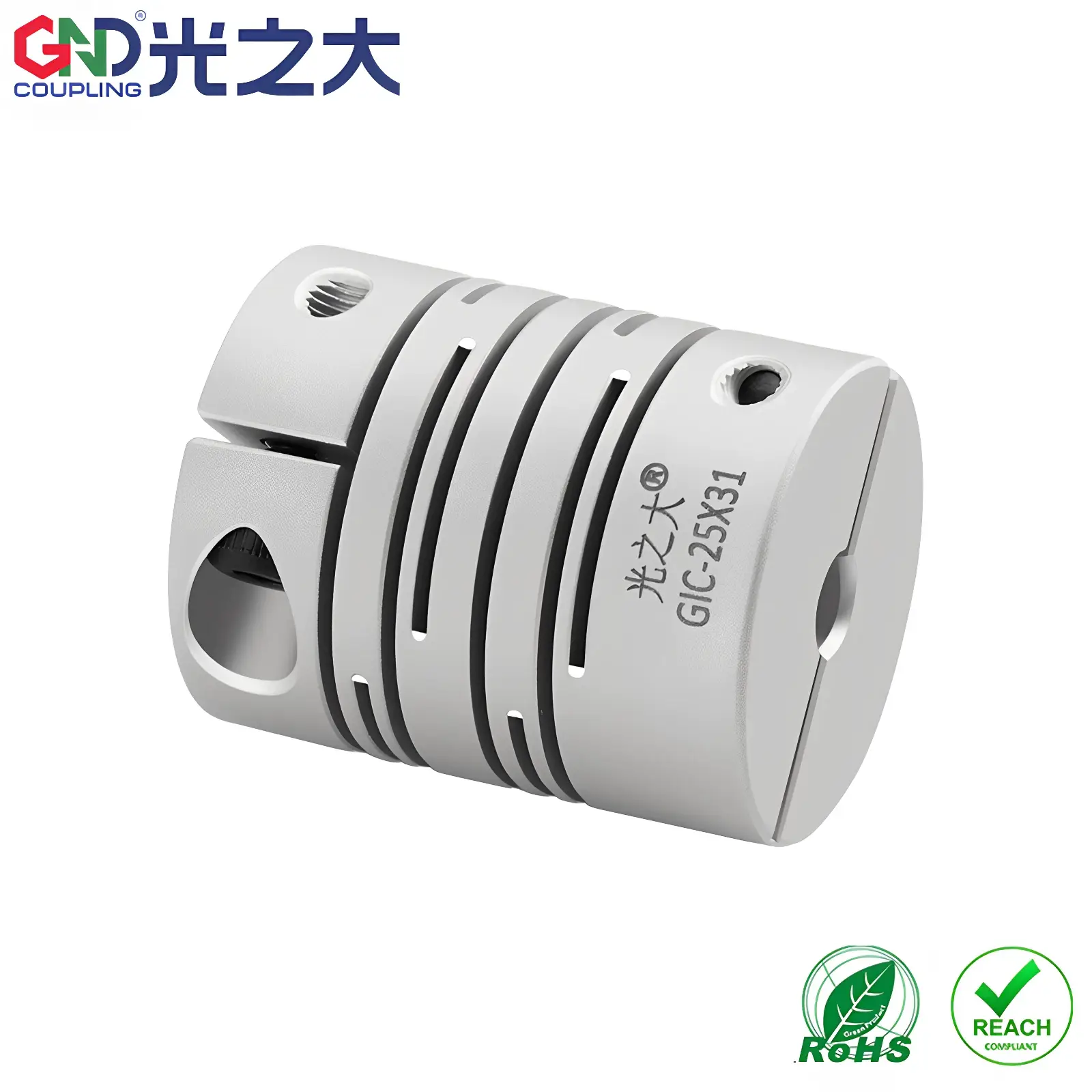
GIC series beam coupling machined from a single piece of anodised aluminium alloy with parallel slit grooves and screw clamp hubs. One piece means zero backlash and nothing to wear out, and the light aluminium body adds very little inertia to the motor, which matters on fast indexing axes and encoder drives. Twenty-one sizes, outer diameters 12 to 63 mm, bores 3 to 30 mm. The GICG series is the same design in 304 stainless steel for wet or corrosive environments.
Technical specifications
| Series | GIC |
|---|---|
| Coupling type | Beam coupling, parallel slit, single piece |
| Material | Aluminium alloy |
| Surface treatment | Anodised |
| Shaft attachment | Clamp type hub (screw clamp) |
| Outer diameter range | 12 mm to 63 mm |
| Bore range | 3 mm to 30 mm depending on size |
| Backlash | Zero, one-piece construction |
| Wearing parts | None |
| Misalignment | Angular, parallel and axial |
| Related series | GICG is the 304 stainless steel version |
| Brand and origin | GND / Guangzhida, Dongguan, China |
| Typical applications | Encoders, stepper and light servo axes, small linear modules, laboratory and semiconductor equipment, instruments |
Available sizes
Each size is ordered with the two bore diameters you need, one for the motor shaft and one for the driven shaft.
| Size (outer diameter x length) | Bore range |
|---|---|
| 12 x 14 mm | 3 to 5 mm |
| 12 x 18.5 mm | 3 to 6 mm |
| 16 x 16 mm | 4 to 6.35 mm |
| 16 x 18 mm | 4 to 6.35 mm |
| 16 x 23 mm | 4 to 6.35 mm |
| 19 x 23 mm | 4 to 8 mm |
| 20 x 20 mm | 5 to 10 mm |
| 20 x 26 mm | 5 to 10 mm |
| 25 x 25 mm | 6 to 12 mm |
| 25 x 31 mm | 6 to 12 mm |
| 28.5 x 38 mm | 6 to 14 mm |
| 32 x 32 mm | 8 to 16 mm |
| 32 x 41 mm | 8 to 16 mm |
| 38 x 41 mm | 8 to 19 mm |
| 40 x 50 mm | 8 to 20 mm |
| 40 x 56 mm | 8 to 20 mm |
| 42 x 50 mm | 10 to 24 mm |
| 50 x 50 mm | 10 to 28 mm |
| 50 x 71 mm | 10 to 24 mm |
| 63 x 71 mm | 12 to 30 mm |
| 63 x 90 mm | 12 to 30 mm |
How to order
Couplings are quoted per order, with no price shown on the site. Send us the series GIC, the outer diameter and length you need, and the two bore diameters, for example GIC-25X31 with 8 mm and 10 mm bores. If you do not know which size fits, send the motor shaft diameter, the driven shaft diameter, the torque and the space available between the two shafts, and our engineers select it for you. RendatSP ships to Saudi Arabia, Iraq, the UAE, Egypt, Oman, Libya, Morocco, Mauritania, Yemen, Algeria, Jordan and Syria.
Frequently asked questions
Aluminium or stainless beam coupling?
Aluminium is lighter, so it adds less inertia and costs less, and it is the usual choice inside a dry machine. Stainless carries more torque and survives washdown, humidity and chemicals. The GICG series is the stainless equivalent of this coupling.
Two lengths are listed for the same diameter. Which do I take?
The longer body flexes over a greater distance, so it tolerates more misalignment and puts less load on the bearings. Take the longer one if the space allows, and the short one when the gap between shaft ends is tight.
Is there really no backlash?
None. The coupling is cut from one piece of metal, so there is no joint anywhere in the torque path. That is why beam couplings are used on encoders, where even a small amount of lost motion shows up as a position error.
Can it take shock loads?
Only modest ones. There is no elastomer to absorb a shock, so a hard impact is transmitted straight through and can crack the slit section. For shock and vibration, use a jaw coupling with a rubber or polyurethane element.
How do I choose between this and a disc coupling?
A disc coupling is stiffer in torsion and carries more torque for its size; a beam coupling is simpler, cheaper and more compact at small diameters. Below about 25 mm outer diameter the beam coupling is usually the practical choice.