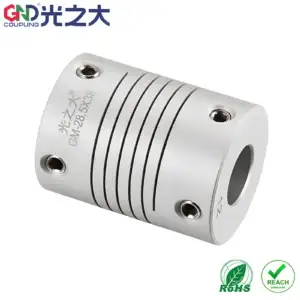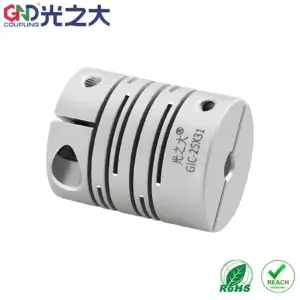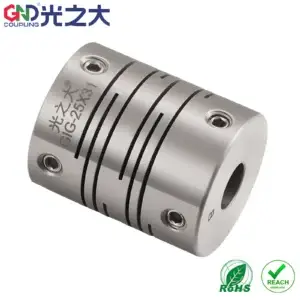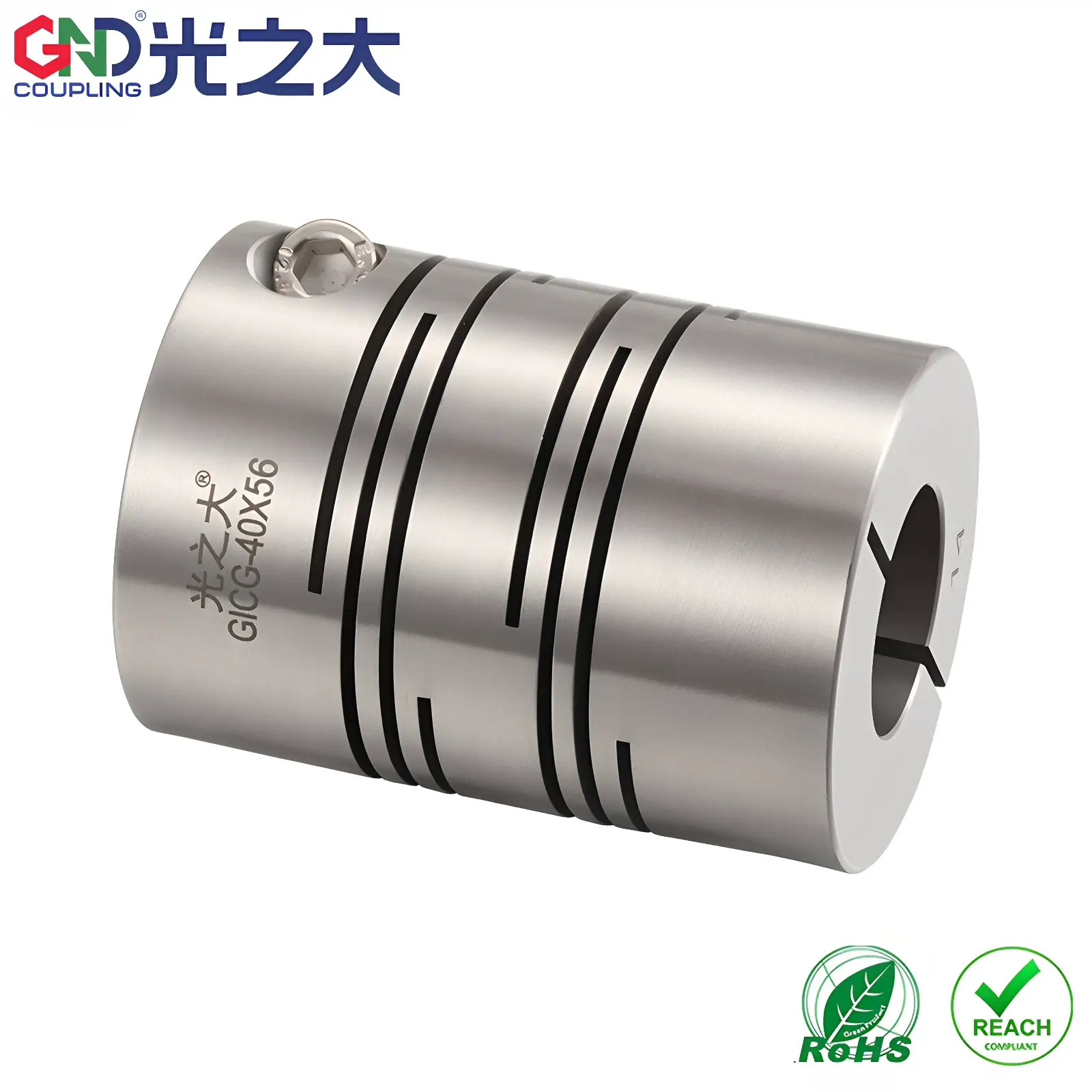
GICG series beam coupling machined from a single piece of 304 stainless steel with parallel slit grooves and a polished finish. Being one piece it has zero backlash and no wearing parts, and the slit pattern lets it flex for angular, parallel and axial misalignment in a very short body. The clamp hubs grip plain shafts without marking them. Stainless construction suits washdown, food, medical and corrosive environments. Twenty sizes, outer diameters 12 to 63 mm, bores 3 to 30 mm.
Technical specifications
| Series | GICG |
|---|---|
| Coupling type | Beam coupling, parallel slit, single piece |
| Material | 304 stainless steel |
| Surface finish | Polished |
| Shaft attachment | Clamp type hub (screw clamp) |
| Outer diameter range | 12 mm to 63 mm |
| Bore range | 3 mm to 30 mm depending on size |
| Backlash | Zero, one-piece construction |
| Wearing parts | None |
| Misalignment | Angular, parallel and axial |
| Environment | Suits washdown, food, medical and corrosive environments |
| Brand and origin | GND / Guangzhida, Dongguan, China |
| Typical applications | Encoders, stepper and light servo axes, small linear modules, laboratory and medical equipment, instruments |
Available sizes
Each size is ordered with the two bore diameters you need, one for the motor shaft and one for the driven shaft.
| Size (outer diameter x length) | Bore range |
|---|---|
| 12 x 14 mm | 3 to 5 mm |
| 12 x 18.5 mm | 3 to 6 mm |
| 16 x 16 mm | 4 to 6.35 mm |
| 16 x 18 mm | 4 to 6.35 mm |
| 16 x 23 mm | 4 to 6.35 mm |
| 19 x 23 mm | 4 to 8 mm |
| 20 x 20 mm | 4 to 8 mm |
| 20 x 26 mm | 4 to 8 mm |
| 25 x 25 mm | 6 to 12 mm |
| 25 x 31 mm | 6 to 12 mm |
| 28.5 x 38 mm | 6 to 14 mm |
| 32 x 32 mm | 8 to 16 mm |
| 32 x 41 mm | 8 to 16 mm |
| 38 x 41 mm | 10 to 20 mm |
| 40 x 50 mm | 10 to 20 mm |
| 40 x 56 mm | 10 to 20 mm |
| 50 x 50 mm | 12 to 28 mm |
| 50 x 71 mm | 12 to 28 mm |
| 63 x 71 mm | 10 to 30 mm |
| 63 x 90 mm | 10 to 30 mm |
How to order
Couplings are quoted per order, with no price shown on the site. Send us the series GICG, the outer diameter and length you need, and the two bore diameters, for example GICG-25X31 with 8 mm and 10 mm bores. If you do not know which size fits, send the motor shaft diameter, the driven shaft diameter, the torque and the space available between the two shafts, and our engineers select it for you. RendatSP ships to Saudi Arabia, Iraq, the UAE, Egypt, Oman, Libya, Morocco, Mauritania, Yemen, Algeria, Jordan and Syria.
Frequently asked questions
What is the advantage of a one-piece beam coupling?
There is nothing to wear out and nothing to replace: no spider, no sliding disc, no separate diaphragm pack. It has zero backlash from the first day to the last, and it is the most compact way to get a flexible, backlash-free connection on a small shaft.
Why stainless steel rather than aluminium?
Stainless resists corrosion, washdown chemicals and humidity, which matters in food, pharmaceutical, medical and marine equipment. It is also stronger, so a stainless beam coupling carries more torque than an aluminium one of the same size. Aluminium is chosen when low inertia matters more than strength.
Is a beam coupling torsionally stiff enough for a servo axis?
For light servo and stepper axes, yes. For a demanding positioning axis with high torque, a disc or bellows coupling is stiffer. Tell us the motor torque and the accuracy you need and we will say which type fits.
What is the difference between the parallel slit and the spiral type?
A parallel slit beam, as used here, is stiffer in torsion and better where accuracy matters. A spiral or helical slit is more flexible and forgiving of misalignment but winds up more under load. We supply both, so tell us which behaviour you need.
How tight should the clamp screws be?
Use the torque marked on the hub or given in the datasheet, and tighten with a torque wrench. Overtightening distorts the bore and undertightening lets the coupling slip on the shaft under reversing loads.